Cast Ingots
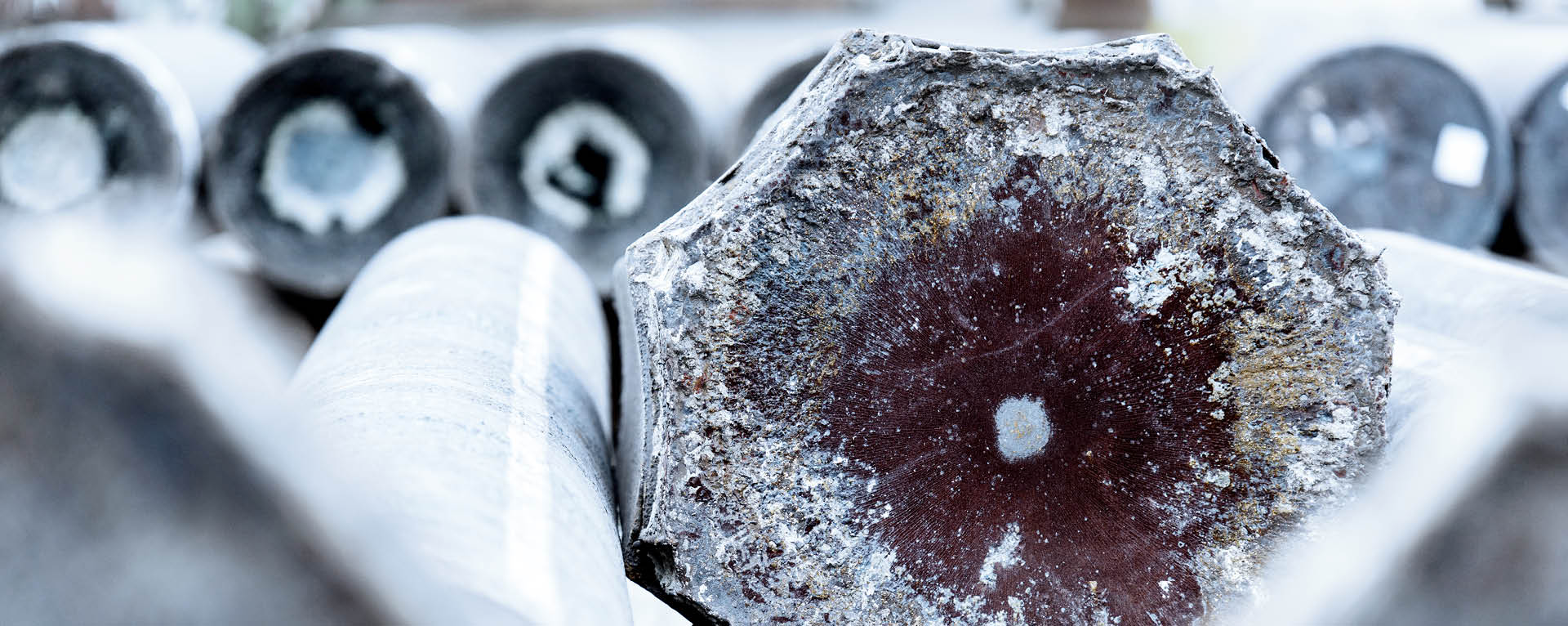
Stahlwerk Bous manufactures order-specific steel cast ingots as semi-finished products for forging shops, ring rolling mills and other demanding downstream processing routes. The available steel grades include quenched and tempered steels, case-hardening steels, bearing steels, heat-resistant steels for high-temperature service, PHFP steels, hot-working and tool steels, and stainless steels.
Production begins by melting 100% recycled steel scrap in an electric arc furnace (EAF). The melt then undergoes secondary metallurgy in VD/VOD facilities, where the required chemical composition and material properties are adjusted according to the applicable customer specification. For applications with particularly demanding cleanliness requirements, ESR ingots produced by electroslag remelting are also available.
Specifications and Formats of Steel Cast Ingots
All steel ingots are manufactured on an order-specific basis according to customer requirements.
Verfügbare Formate und Stückgewichte
Available Formats and Unit Weights
| Format | Unit Weight Range | Geometry / Cross Section | Typical Further Processing |
|---|---|---|---|
| Round | 1.1–62 t | max. Ø 2,300 mm | Open-die forging, ring rolling, pipe mills |
| Square | 3.7–62 t | square cross section | Open-die forging, closed-die forging |
| Polygonal | 3.7–76.5 t | multi-sided | Open-die forging, large-scale components |
| Slabs | 10.5–79 t | flat rectangular | Rolling mills, plate products |
| ESR ingots | 3.8–84 t | round / polygona | Safety-critical applications, aerospace, energy |
Material Spectrum by Application
We produce more than 800 steel grades within close analytical limits, ranging from unalloyed structural and engineering steels to case-hardening steels, quenched and tempered steels, bearing steels, heat-resistant steels, high-alloy steels and cold-tough grades.
The following overview shows the available material spectrum by application:
| Material Group | Typical Applications | Standards (Selection) |
|---|---|---|
| Unalloyed steels / structural steels | General mechanical engineering, construction | EN 10025, EN 10222-1, EN 10250-1, EN 10250-2 (DIN 17100); EN 10083-1, EN 10083-2 (DIN 17200) |
| Case-hardening steels | Gears, shafts, drive components | on request |
| Quenched and tempered steels | Highly stressed shafts, large flanges | DIN 17173, DIN 17176, DIN 17204, EN 10269 (DIN 17240), EN 10083-1, SEW 550 |
| Highly stressed shafts, large flanges | Bearing rings, rolling elements | on request |
| PHFP steels | Automotive, mechanical engineering | on request |
| Hot-work and tool steels | Dies, die-casting moulds | on request |
| Heat-resistant steels / steels for high-temperature service | Seamless tubes and forgings | DIN 17175; EN 10222-1 (DIN 17243); EN 10028; SEW 028 |
| High-alloy and stainless steels | Energy, chemical industry, offshore | EN 10084 (DIN 17210), EN 10088, SEW 555 |
| Cold-tough steel grades | LNG plants, arctic applications | DIN 17173, DIN 17174, DIN 17280, EN 10028-1, EN 10028-4, EN 10222-1, EN 10222-3, EN 10269 |
| International specifications | Depending on steel grade, product requirements and customer specification | ASTM-A105, A182, A350, A519, A694 · UNI 7874, UNI 8550 |
| Internationale Normen (alle Gruppen) | Abhängig von Stahlgüte, Produktanforderungen und Kundenspezifikation | ASTM-A105, A182, A350, A519, A694 · UNI 7874, UNI 8550 |
Your contact for Cast Ingots
We manufacture all our products to customer specifications. So what are your specifications?
Please feel free to contact us. Together we will find your perfectly customized solution.

Boris Šorn
Sales Director Steel & Semis Stahlwerk Bous GmbH
Applications of Steel Cast Ingots
Steel cast ingots from Stahlwerk Bous are used as primary material for demanding downstream processes, particularly where large dimensions and demanding mechanical requirements are involved.
Railway Engineering
In railway engineering, cast ingots are used as starting material for selected safety-critical wheelset components. Stahlwerk Bous holds a Deutsche Bahn AG manufacturer-related product qualification (HPQ) covering defined applications, including:
- Monobloc wheels
- Wheel centres
- Wheel tyres—continuous casting only
Standards and material grades include:
DIN EN 13262, DB BN 918 277, DB BN 918 276, DB BN 918 048, UIC 810V / 812V, material grades ER7, ER8, ER9 and 24CrMo4
Open-Die Forging and Closed-Die Forging
Cast ingots serve as starting material for the production of large forged components with demanding mechanical requirements, including:
- Shafts
- Rings
- Flanges
- Pressure vessel components
Ring Rolling Mills
Round ingot formats are used as pre-material for the production of seamless rings and large bearing components in ring rolling processes, for applications such as:
- Wind energy
- Power generation
- Heavy mechanical engineering
Energy and Power Generation
Cast ingots are used for pressure-retaining and highly stressed components, including:
- Turbine shafts
- Pressure vessels
- Flanges and structural components
Manufacturing is carried out in accordance with:
AD 2000 and Pressure Equipment Directive 2014/68/EU (TÜV-certified)
Pipe Mills (Seamless Pipe Production)
Round ingots are used as starting material for the production of:
- Thick-walled hollow bodies
- Seamless pipes
Applications include oil & gas, petrochemical, and energy infrastructure, depending on the customer’s processing route.
Mechanical and Plant Engineering
Steel cast ingots are used for the production of large-scale and customized components, such as:
- Housings
- Axles
- Flanges
- Tooling and moulds
The steel ingots are manufactured according to customer-specific material, format and processing requirements.
Your contact for Cast Ingots
We manufacture all our products to customer specifications. So what are your specifications?
Please feel free to contact us. Together we will find your perfectly customized solution.
Boris Šorn
Sales Director Steel & Semis Stahlwerk Bous GmbH
Frequently Asked Questions
What is ingot casting in steel production?
In ingot casting, steel scrap is first melted in an electric arc furnace (EAF). The molten steel is then treated in VD/VOD facilities, where its chemical composition and material properties are adjusted according to the applicable customer specification. It is subsequently poured into individual moulds and allowed to solidify.
The process enables the production of order-specific steel ingots in different formats, unit weights and steel grades. These ingots are used as semi-finished material for forging, ring rolling and other downstream processing routes.
What is the difference between ingot casting and continuous casting?
Both ingot casting and continuous casting are established steel production methods, but they serve different industrial requirements.
Ingot casting is used for:
- Large unit weights
- Complex and high-performance steel grades
- Maximum flexibility in downstream processing
Continuous casting is optimized for:
- High production volumes
- Smaller cross-sections
- Cost-efficient series production
The appropriate casting route depends on the required unit weight, steel grade, cross-section and downstream processing route.
What unit weights are available for steel ingots?
Stahlwerk Bous supplies cast ingots in the following formats and unit-weight ranges:
- Round: 1.1–62 t, up to Ø 2,300 mm
- Square: 3.7–62 t
- Polygonal: 3.7–76.5 t
- Slabs: 10.5–79 t
- ESR (ESU) ingots: 3.8–84 t
All formats are manufactured to customer specification.
What are the advantages of electroslag-remelted (ESR) ingots?
ESR improves steel cleanliness, reduces non-metallic inclusions and enhances mechanical properties, making ESR/ESU ingots suitable for critical applications in the energy, railway and offshore industries.
Which industries use steel cast ingots?
Steel cast ingots are used across a range of demanding industrial sectors, including energy and power generation, oil and gas, offshore technology, railway engineering, forging, and heavy machinery.
Which certifications and approvals does Stahlwerk Bous have for ingot casting?
Stahlwerk Bous GmbH is certified according to ISO 9001:2015, ISO 14001:2015 and ISO 50001:2018. For industry-specific applications, approvals exist from Deutsche Bahn AG (manufacturer-related product qualification HPQ for railway components). Further certificates are available in the download section.
Your contact for Cast Ingots
We manufacture all our products to customer specifications. So what are your specifications?
Please feel free to contact us. Together we will find your perfectly customized solution.
Boris Šorn
Sales Director Steel & Semis Stahlwerk Bous GmbH
Further processing possibilities
Heat treatment
Annealing
Mechanical processing options
Cropping / Sawing
What you can expect
Raw material recycling
We use almost 100 % scrap in our low-CO2 steel production, thereby enabling closed loops
Broad portfolio
We offer a wide range of different block formats and weights
Wide range of options
We have a wide range of materials to meet your exact requirements