Why Specialized Steel Is Critical to Modern Industry
What does an electric motor, an aircraft bearing, a die used in automotive production and a component for a fusion reactor have in common?
Each relies on steel with properties developed for a particular application. Depending on the component, this may mean exceptional strength, resistance to wear and corrosion, or the ability to withstand repeated mechanical and thermal loads.
At GMH Gruppe, these requirements are addressed through a combination of metallurgical expertise and manufacturing capabilities. Across its companies, steel is developed, melted, remelted, forged, cast, heat-treated and machined – from precisely specified materials to finished industrial components.
The steel inside electric mobility
Electric vehicles may be associated with batteries and software, but their drivetrains still depend on highly stressed mechanical components.
Georgsmarienhütte GmbH produces specialized bar steel used to manufacture components such as electric motor rotor shafts. With a portfolio of more than 500 steel grades, the company can adapt material compositions and properties to specific customer requirements.
Strength, fatigue resistance and machinability are particularly important for these applications. The steel is produced from recycled scrap in an electric arc furnace, combining specialized metallurgy with a lower-emission production route.
Steel that helps manufacture the car
Specialized steel is also essential to the tools used in automotive manufacturing.
At Kind & Co. in Wiehl, more than 40 years of experience in hot-work tool steel supports die-casting applications.
The company’s MT1 grade was developed for large structural components and giga-casting. These processes require increasingly large dies that must withstand repeated heating and cooling cycles, high mechanical loads and considerable temperature differences.
MT1 combines toughness, homogeneity and hardenability to achieve consistent hardness across large mould dimensions. Its alloy design also helps reduce the risk of bainite formation during heat treatment, supporting dimensional stability and reducing reworking.
For manufacturers, these properties influence die performance, production reliability and operating costs.
When conventional metallurgy reaches its limits
At Energietechnik Essen (ETE), the focus shifts to high-nitrogen steels.
One example is Cronidur® 30, a martensitic stainless steel used in aerospace, precision bearings and medical technology.
Its production relies on Pressure Electroslag Remelting (P-ESR). By operating under pressure, ETE can introduce nitrogen beyond conventional solubility limits while controlling the remelting process.
The resulting material combines high strength and toughness with wear and corrosion resistance – properties required in highly loaded bearings and precision components.
In 2026, ETE has invested more than €11 million in new and modernized remelting technology at its Essen site.
The company also manufactures rotor retaining rings for large generators operating at speeds of up to 3,600 rpm. These components secure the rotor windings against centrifugal forces, requiring high material strength and precise manufacturing.
Steel for fusion research
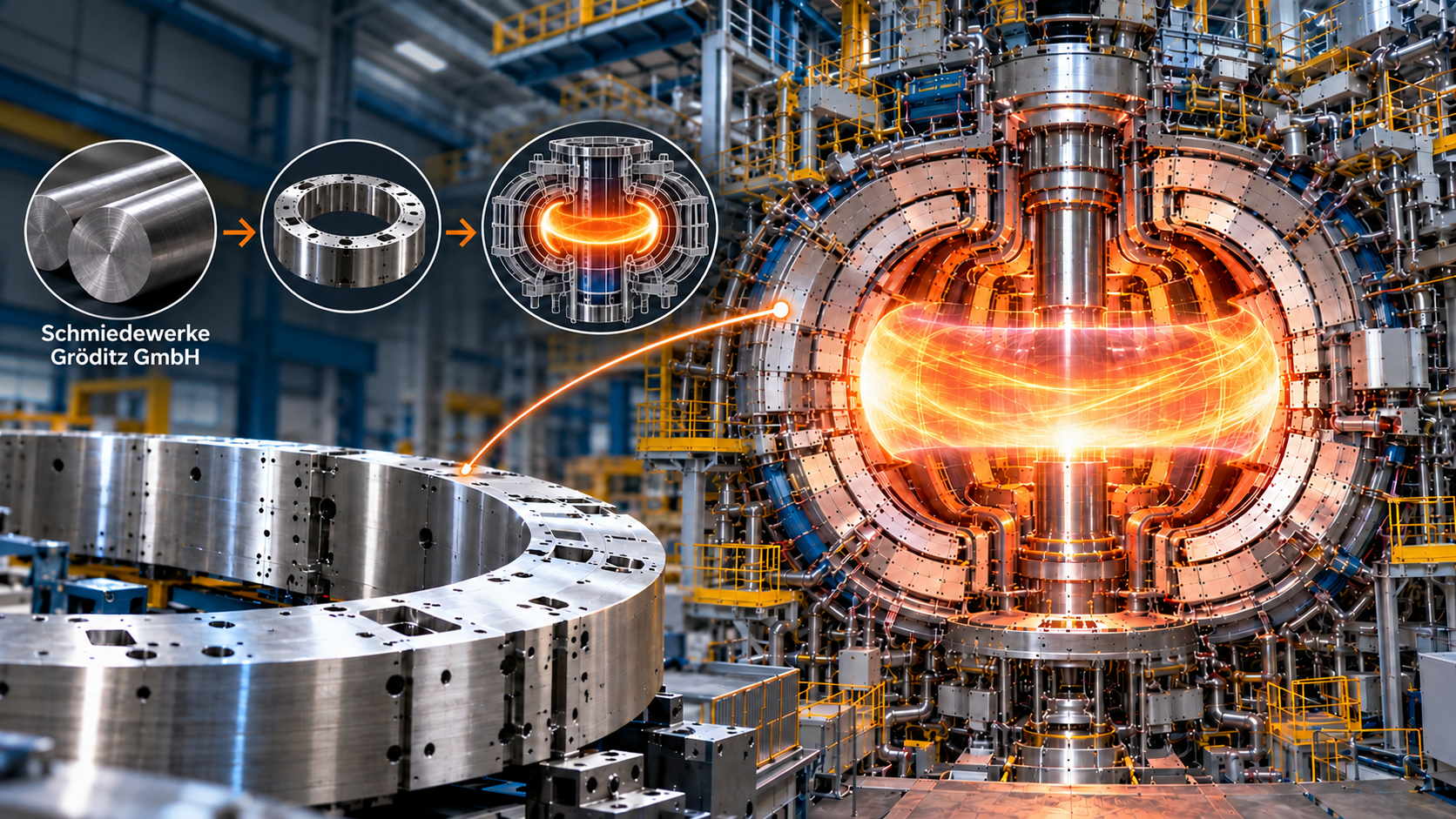
Few applications illustrate the complexity of material engineering as clearly as nuclear fusion research.
At ITER, the international fusion research project in France, plasma temperatures are designed to reach approximately 150 million degrees Celsius. Components used in the reactor must meet specific mechanical, magnetic and thermal requirements.
GMH Gruppe has supplied more than 7,000 tonnes of specialized steel for the project.
Schmiedewerke Gröditz and Kind & Co. developed non-magnetisable, high-strength and oxidation-resistant steels for reactor applications. The work also included specially shaped forged components, including bends and crescent-shaped elements for vacuum-tight sections of the reactor vessel.
Their production requires precise control of material composition, forging and subsequent processing to achieve the specified properties and geometries.
From specialized steel to engineered components
GMH Gruppe’s capabilities extend from steel development and production to remelting, forging, casting, heat treatment and precision machining. Depending on the application, customers receive precisely specified steel or components manufactured through several of these processes.
The examples from automotive manufacturing, aerospace, power generation and fusion research illustrate the breadth of this expertise – and the role of specialized steel in some of modern industry’s most technically complex applications.



Would you like to join us as
a decarbonization pioneer?
With us, you can lead your company into a green future.